 Student protesters at Princeton have touched off a wide debate about racism and the former president’s proper place in history.
Sunday, November 29, 2015
Woodrow Wilson’s Legacy Gets Complicated
Student protesters at Princeton have touched off a wide debate about racism and the former president’s proper place in history.

Saturday, November 28, 2015
How to Answer the Nasty Little Question Buyers and Interviewers Love to Ask
There is one question that often strikes fear in both sales people and job candidates. For this reason, I call it the "nasty little question." In sales situations, this question usually takes the form of "What's wrong with your product? For job interviews, it usually morphs to, "What are your weaknesses?" Before providing advice on how to best answer this question, it is useful to first understand the underlying psychology behind why interviewers and prospective customers so often ask it.
Why prospects and job interviewers ask this question
In sales situations, buyers feel as if they are at a disadvantage. Sellers have the advantage of being comfortable in their place of business selling a product that they know better than the buyer. To level the playing field, buyers typically resort to this question to throw the seller off balance and to try to gain a negotiating advantage. During interviews, interviewers have a similar agenda. They want to throw job candidates off balance, test their ability to answer similar questions they will likely get from buyers, and get some indication how they think on their feet under difficult "real-world" conditions. In general, it is a "trick" or challenging question.
It's usually a mistake to admit a weakness
While most sales people and job candidates feel compelled to admit a weakness, this is a very risky move. Many will not believe the most common answers, which attempt to disguise strengths as weaknesses ("I work too hard" or "the product lasts forever"). Additionally, some interviewers may have the idea in their mind that workaholics are unhappy and unpleasant to work with. After this question was asked in the October 28, 2015 Republican Presidential debate, "Late Show" host Stephen Colbert joked...
Colbert went on to tell his audience that when he interviewed for the "Late Show" job...
Walking the tight rope
While Colbert can be funny and get away with it, most people have to "walk a tight rope" to successfully answer. I don't agree with Colbert. To succeed, you have to answer honestly, but not admit a weakness. Sales people and job applicants have to tell the truth because they have to develop a trusting relationship with their customer and employers. Nobody trusts liars, and lies usually are uncovered sooner or later. At the same time, if they admit a weakness, it is likely to ruin the sale or cause the interviewer to hire someone else. Furthermore, admitting you have a weakness is what is in your own head. It has little to do with what the employer or buyer wants. In fact, if you admit to weaknesses, you might be labeled as a "head case" that lacks confidence and is unable to function in a normal working environment.
Why admitting a weakness is usually a big mistake
In addition to being an obstacle to getting the job or making the sale, admitting a weakness is often the wrong answer. Huh? Don't all humans and products have weaknesses? Of course, nobody is perfect. That is not the issue. This issue is "What does the customer want?" Only the buyer can make that determination. The seller cannot. The seller might prefer chocolate, whereas the buyer prefers vanilla. If the customer asks you what's wrong with the product? In your mind, the honest answer is that it is not chocolate. However, the customer wants vanilla so asking you does not add any value. In fact, it would give the buyer the wrong answer from the buyer's point of view.
Structuring the answer to the nasty little question
The first question the sales person should ask the prospective buyer is "What do you want?" The job candidate should ask a similar question, such as, "What qualifications are you looking for to fill this position." This is usually answered in the posted job description. When the interviewer or buyer asks about weaknesses, perhaps the best answer (if it's true) is
Universal marketing truths to support your answer
It is important to remember that the marketplace is your mirror. You look and sound very different to the rest of the world than you think you do (remember the first time your heard your voice on a tape recorder). This is why you cannot properly answer the question for a buyer or employer. You have to always reference your answer to what they told you they want.
Avoiding the traps
To better compete, potential buyers of what you are selling often ask the nasty little question - "What's wrong with your product?" or "What are your weaknesses?" I hope that this post has given you the tools you need to answer this question so you better succeed at getting hired and selling products.


Why prospects and job interviewers ask this question
In sales situations, buyers feel as if they are at a disadvantage. Sellers have the advantage of being comfortable in their place of business selling a product that they know better than the buyer. To level the playing field, buyers typically resort to this question to throw the seller off balance and to try to gain a negotiating advantage. During interviews, interviewers have a similar agenda. They want to throw job candidates off balance, test their ability to answer similar questions they will likely get from buyers, and get some indication how they think on their feet under difficult "real-world" conditions. In general, it is a "trick" or challenging question.
It's usually a mistake to admit a weakness
While most sales people and job candidates feel compelled to admit a weakness, this is a very risky move. Many will not believe the most common answers, which attempt to disguise strengths as weaknesses ("I work too hard" or "the product lasts forever"). Additionally, some interviewers may have the idea in their mind that workaholics are unhappy and unpleasant to work with. After this question was asked in the October 28, 2015 Republican Presidential debate, "Late Show" host Stephen Colbert joked...
"No one in human history has ever answered honestly."
Colbert went on to tell his audience that when he interviewed for the "Late Show" job...
"I said my biggest weakness was sometimes I work so hard I forget to cash my paychecks."
Walking the tight rope
While Colbert can be funny and get away with it, most people have to "walk a tight rope" to successfully answer. I don't agree with Colbert. To succeed, you have to answer honestly, but not admit a weakness. Sales people and job applicants have to tell the truth because they have to develop a trusting relationship with their customer and employers. Nobody trusts liars, and lies usually are uncovered sooner or later. At the same time, if they admit a weakness, it is likely to ruin the sale or cause the interviewer to hire someone else. Furthermore, admitting you have a weakness is what is in your own head. It has little to do with what the employer or buyer wants. In fact, if you admit to weaknesses, you might be labeled as a "head case" that lacks confidence and is unable to function in a normal working environment.
Why admitting a weakness is usually a big mistake
In addition to being an obstacle to getting the job or making the sale, admitting a weakness is often the wrong answer. Huh? Don't all humans and products have weaknesses? Of course, nobody is perfect. That is not the issue. This issue is "What does the customer want?" Only the buyer can make that determination. The seller cannot. The seller might prefer chocolate, whereas the buyer prefers vanilla. If the customer asks you what's wrong with the product? In your mind, the honest answer is that it is not chocolate. However, the customer wants vanilla so asking you does not add any value. In fact, it would give the buyer the wrong answer from the buyer's point of view.
Structuring the answer to the nasty little question
The first question the sales person should ask the prospective buyer is "What do you want?" The job candidate should ask a similar question, such as, "What qualifications are you looking for to fill this position." This is usually answered in the posted job description. When the interviewer or buyer asks about weaknesses, perhaps the best answer (if it's true) is
"In the context of what you want, I don't see any."
Universal marketing truths to support your answer
It is important to remember that the marketplace is your mirror. You look and sound very different to the rest of the world than you think you do (remember the first time your heard your voice on a tape recorder). This is why you cannot properly answer the question for a buyer or employer. You have to always reference your answer to what they told you they want.
- Outside-in thinking. If you are self-focused (explaining what you think are your, or your product's, weaknesses), you are likely to provide the wrong answer. You have to think outside-in and find out what the customer or interviewer wants.
- Relativity. The universe is governed by relativity. Everything, except the speed of light (which is a constant) is relative. In marketing terminology, it is based on the lock (the market segment with the unfilled need) and key (the image of your product that fills that need better than competitors). You need different keys for different locks. Some prefer chocolate and others prefer vanilla. Some women like sensitive guys. Others prefer macho guys. If you are a man talking with a women that likes sensitive guys, being sensitive is not a weakness. It's a strength. If you say it is a weakness, you are making the decision for the customer, which will not work.
- Testing you. In a job interview, the interviewer is interested in discovering how you can handle objections. By asking you "What are your weaknesses?" they are testing how you will handle the situation when customers ask you about their products. If you say that you have a weakness, the interviewer is likely to think that you will say the same thing about the company's products, and you are not likely to get the job.
- Intelligence question number one (What do you want?). This will save you in most cases. In a job interview, the job description is your question #1. You can say, "I read your job description, and I do not see any weaknesses. Of course that has to be true. Now, if you do see a weakness, such as you are not an expert in Excel, you can say that you have a working knowledge of Excel, but you are not an expert and that you are willing to work on it on your own time to be as proficient as they want you to be.
- Objectivity answer. If you have a super difficult interviewer that insists on your identifying a weakness, you can give them perhaps the most honest of answers, "I cannot be objective about myself. It is up to my boss to identify any areas where I need to improve. If that happens, I work on this area on my own time to turn it into a strength." You should be ready with an example if they ask for one. If the question is about a product you are selling, you can say, "Based on what you told me you want it to do, I see no weaknesses. In fact, it will do what you want better than other alternatives on the market." Again, this has to be true. If they want to do something your product does not do well, you have to disclose that, and ask them how important that capability is relative to the others your product offers.
Avoiding the traps
To better compete, potential buyers of what you are selling often ask the nasty little question - "What's wrong with your product?" or "What are your weaknesses?" I hope that this post has given you the tools you need to answer this question so you better succeed at getting hired and selling products.
-- This feed and its contents are the property of The Huffington Post, and use is subject to our terms. It may be used for personal consumption, but may not be distributed on a website.
Mileniales Abren Camino y Crean Esperanza: ¡Viajes Ecológicos para Estimular su Negocio!
Co-authored by Jacquelyn Crutchley, Chief Operating Officer of Schools for Sustainability, Inc. and translated by Marisel Villarreal Rios, Schools for Sustainability, Inc professional translator and editor.
¿Alguna vez ha imaginado seguir su corazón e ido a tomarse un viaje a Perugia, unirse a AmeriCorps o abrir ese pequeño negocio que usted siempre había soñado? Hace dos años atrás, las fundadoras de Schools for Sustainability, Inc., Alyssa Ramos Reynoso (CEO) y Jacquelyn Nicole Crutchley (COO), compartieron un sueño de enfrentar la pobreza y cuidar el ambiente a través de la educación. Juntas, tomaron el riesgo de seguir sus corazones y hoy día está dando fruto.
Schools for Sustainability, Inc. (S4S) se asoció con Arcadia University en marzo de 2015. S4S tomó un grupo de 15 estudiantes, de primer año y de traslado, de Arcadia University a la República Dominicana. La clase fue guiada por dos profesoras, la Dra. Erica Davila y la Dra. Rochelle Peterson.
En la República Dominicana, el grupo pasó cuatro días construyendo una unidad acuapónica y conduciendo una encuesta comunitaria en Monte Plata.

Schools for Sustainability, Inc. cree que las comunidades empobrecidas saben mejor la solución de sus problemas pero a menudo no pueden obtener los recursos apropiados. Es natural que una de sus primeras iniciativas fuera hacer una encuesta comunitaria. S4S y los estudiantes de Arcadia University entrevistaron a más de 40 residentes de Sabana Grande de Boya, en Monte Plata, sobre su punto de vista sobre la educación, su vida cotidiana, sus retos y sus familias. Aprendieron que algunas de las necesidades de la comunidad son el acceso a agua potable, el trabajo, y la educación.

(Miembros de Schools for Sustainability, Inc. y los estudiantes voluntarios de Arcadia University con los niños de la comunidad de Sabana Grande de Boya. )
Schools for Sustainability, Inc. y sus voluntarios fueron bienvenidos por niños energéticos corriendo a lo largo de su guagua. Durante las entrevistas, los líderes y miembros de la comunidad se sentaron en cajones, mientras le ofrecían a los voluntarios de S4S que se sentaran cómodamente en sillas plásticas. Hicieron preguntas bien planeadas y compartieron sus expectativas para la futura escuela.
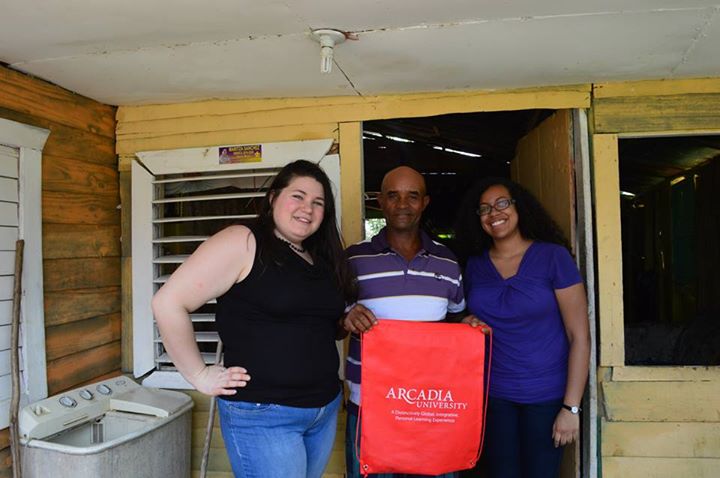
(De izquierda a derecha: Jacquelyn Crutchley (COO), el líder de la comunidad, Manuel - quien se ofreció como voluntario para la escuela - y Alyssa Ramos-Reynoso (CEO).)
"Solo tengo memorias increíbles sobre mi tiempo en la República Dominicana. Dejé un pedazo de mi corazón allá. Pienso en las personas que conocimos y las historias que compartieron. Pienso sobre el paisaje, especialmente el cielo en la noche. Nunca había visto tantas estrellas en mi vida."- María Ignacia Garate. (Estudiante de Arcadia University que atendió el preview trip de Schools for Sustainability, Inc.)

(Foto de Gisele)
"A demás de todas las cosas que hicieron este viaje increíble, forjé una amistad con una niña llamada Gisele, que nunca creo que olvidaré. Echo de menos su risa, sus bromas, y su continuo amor y felicidad".
Proyecto #2- Acuapónica:
Otro grupo de estudiantes trabajó con Christian Brown, el experto de acuaponia y alumno graduado de Drexel university, para construir la unidad acuapónica.

(Christian Brown admirando la unidad acuapónica)
En preparación al viaje, los estudiantes aprendieron sobre acuaponia en clase. No solo abrieron camino con S4S por construir el sistema, también se transformaron en pioneros de la educación sustentable en la República Dominicana por hacerlo. Su investigación llevó al diseño y la construcción de una unidad acuapónica funcional que está siendo monitoreada por Jose, el gestor de la tierra concedida a Schools for Sustainability, Inc.

(El diseño que los estudiantes de Illinois Institute of Art - Schaumburg crearon.)


(Los estudiantes de Arcadia University construyendo la unidad acuapónica.)
El viaje con Schools for Sustainability, Inc. fue la primera vez en el extranjero para Erin Jennifer. "Hace dos meses atrás embarqué en un viaje que cambió mi vida para siempre. Me siento tan inspirada por este lugar y estas personas. Me enseñaron cómo aprovechar lo que tengo, vivir con un corazón agradecido, amar a mi familia, y sacar el mejor provecho de lo que venga en mi camino. No me pudiera sentir más agradecida por esta experiencia, ya que es algo que nunca olvidaré y no puedo esperar a regresar".

(Erin Jennifer enseñando y jugando con los niños de Sabana Grande de Boya.)
¡Vea más fotografías en nuestra página web!
¡Schools for Sustainability, Inc. le da las gracias a Arcadia University, la Dra. Erica Davila, la Dra. Rochelle Peterson, Jody Luna, Christian Brown, los diseñadores y voluntarios, el equipo de la encuesta comunitaria, y a la operadora turística - Isabel Voigt - que hizo el viaje una experiencia increíble e inolvidable!
This article was co-authored by COO Jacquelyn Crutchley. She is a graduate of Arcadia University, having majored in sociology, anthropology and Spanish. She interned in Guatemala and Mexico, doing medical translation and serving as an ombudsman between patients and staff. There she also taught English to students between 4 and 65 years of age. She participated in the 2012 Y20 youth conference, focusing on global food security, and was selected to represent Arcadia University for the Who's Who in American Universities and Colleges in 2013.
This article was translated by Marisel Villarreal Rios. She earned a Bachelor of Arts from Arcadia University in Italian Studies and Spanish Language and Culture. She is currently working as the Bilingual Communications and Writing Specialist in USLI and volunteers to assist in translating the English content for S4S. Marisel´s curiosity, knack for languages, as well as her study abroad experiences in Granada, Spain and Perugia, Italy have inspired her to follow a career in translation and interpretation. A native of Puerto Rico, she grew up understanding the value of education and creating a sustainable environment in which the people in the Caribbean, in this case the Dominican Republic, can enjoy the fruits of their own country. She is excited to be part of this wonderful team!
-- This feed and its contents are the property of The Huffington Post, and use is subject to our terms. It may be used for personal consumption, but may not be distributed on a website.


Amid new battle, NSA to shut down phone records program
 Debate will continue over impact of the program's shutdown on national security.
Thursday, November 26, 2015
‘All right, let’s do this’: Man jumps over White House fence
 A man draped in an American flag was taken into custody Thursday afternoon after he jumped the fence of the White House while the first family was inside...
Tuesday, November 24, 2015
Thanksgiving Travelers Facing Tougher Security Measures
 Americans are likely to see longer security lines and more careful screening during the holiday period. But airlines expect to carry more passengers than they have since 2007.
Sunday, November 22, 2015
Obama to Pentagon: 'Get to the bottom' of altered IS intelligence
 President Obama said Sunday he has told top military officials to "get to the bottom" of reports that intelligence assessments have been altered to give a rosier assessment of progress in turning back the Islamic State.
Saturday, November 21, 2015
There’s a booming black market for fake Syrian passports
 A Syrian passport found by the body of a Paris suicide bomber was a fake.
Thursday, November 19, 2015
An 11-Month Plot To Terrorize Europe
 The Belgian militant suspected of orchestrating the attacks that left 129 dead, was killed in a police raid, French officials said.
Wednesday, November 18, 2015
Airport workers at 7 U.S. hubs to strike Wednesday night
 The workers are protesting what they say are poor working conditions, low wages and retaliation for unionizing.
Tuesday, November 17, 2015
White House holds call with governors on Syrian refugees
 The White House has held a 90-minute conference call with governors about plans to increase the number of refugees accepted in the United States after governors raised concerns related to last week's attacks in Paris.
Sunday, November 15, 2015
Obama, Putin strike chord on Syria as leaders vow to quell terror
 <p>US President Barack Obama and Vladimir Putin of Russia agreed Sunday on the first steps towards peace in Syria, as the Paris attacks jolted world leaders into a crackdown on foreign fighters.</p>
Saturday, November 14, 2015
Purpose at Work: It Comes from Within
Over the last few years a lot has been written about making jobs "purposeful."
Reid Hoffman just posted an article about the importance of purpose, and described how LinkedIn creates purpose. Earlier this year the New York Times described how Mark Bertolini, the CEO of Aetna, has applied purpose to their workforce. And my own research with Glassdoor shows clearly that "culture and values" are the most highly correlated factors in someone's likelihood of recommending their company as a great place to work.

Fig 1: Correlation of "company ratings" to various factors in Glassdoor, n=200,000, August 2015
But as much as I have been a huge fan of building a "purposeful culture" and communicating values and mission in the workplace, some new research by a research firm named Imperative actually shows us something different:
I spoke with Aaron Hurst, the CEO of Imperative a few weeks ago, and he educated me about an existential truth. There are essentially two reasons people choose to work:
Reason 1: Work for financial gain or personal status. (not "purposeful")
Reason 2: Work to help others, contribute, or for personal fulfillment ("purposeful").
Their research shows that everyone in every profession falls into one of these categories. You can be a "purposeful" software engineer (do it for the love of it), or you can be an "unpurposeful" software engineer (do it for the money).
Imperative's research points out some pretty amazing statistics. Those of us who are "purposeful" at work are much higher performers. Specifically, these lucky folks are:
And as Imperative's research shows, being "purpose oriented" is not about the work, it's about YOU.

Fig 2: From Imperative Workforce Purpose Index study
What the Imperative research shows, which I found to be quite profound as I thought about it, is that we are all in control of how we perceive our work.
If we were brought up in a family where the breadwinner came home each night tired and unhappy and sat on the couch drinking beer and complaining, we are likely to see work as drudgery and just a way to get a paycheck. On the other hand, if your father or mother came home excited about work and talked openly about how much fun and excitement they were having (which my father did every day), then we look at work as a place to find self-fulfillment.
Think about this. You have the power to make your work more meaningful! (It may mean quitting and changing jobs of course, but remember - much of happiness is based on the stories we tell ourselves in our own head.)
Now here's the unfortunate news.
Imperative's research, sadly, found that only about 1/4 of us are in the lucky position to find work meaningful.
 This, to me, is incredibly sad. And there are trends here:

Fig 3: Purpose-Orientation by Industry, Imperative study
So What Does This All Mean
For me, after spending almost two decades studying work and talent practices, I take away a few profound findings:
1. If you're an employer, you should seek out people who "want to do the job you're hiring for" - people who love it for its own sake, people who love your company's mission, and people who genuinely like to help others. These people are relatively easy to spot, and while they may not be the most "ambitious" (many are), these are clues you can spot. (We have always had people like this apply to work at Bersin.)
2. If you're and HR manager or business leader, you should work hard to create jobs that can offer meaning to people. Give people autonomy and freedom to create and innovate; give them flexibility to work the way they want; thank them regularly for their efforts; and give them a clear mission and view of the organization's goals so they can find their own purpose at work.
(You can read more about how to build a "Simply Irresistible" workplace in my article explaining the new world of employee engagement here.)
3. If you're a recruiter or hiring manager, remember to ask people "why are you applying for this job?" This simple question will tell you about someone's purpose-orientation, and give you a clue as to how well they will adapt, grow, and contribute to your organization.
4. If you are a job seeker (and aren't we all?), take some time to rethink your own motivation. What do you really want to get out of work? How do you define your own measure of "success"? Can you think more about your impact on others and less about your personal gain? Are there tasks, jobs, organizations that really excite you that you can look for?
The bottom line message is pretty simple. We all spend 50-70% of our working hours in some kind of trade, job, or profession. If we don't really like it, it's up to us to change. We may need to change what we do, change the team we're on, or change the company we're in. Or we may need to change our own attitude.
Every individual at work deserves an opportunity to find purpose. I'd challenge you - for yourself and the others around you - to look for purpose in a serious and deliberate way. It will make you happier, healthier, and more successful in all areas of your life.


Reid Hoffman just posted an article about the importance of purpose, and described how LinkedIn creates purpose. Earlier this year the New York Times described how Mark Bertolini, the CEO of Aetna, has applied purpose to their workforce. And my own research with Glassdoor shows clearly that "culture and values" are the most highly correlated factors in someone's likelihood of recommending their company as a great place to work.
Fig 1: Correlation of "company ratings" to various factors in Glassdoor, n=200,000, August 2015
But as much as I have been a huge fan of building a "purposeful culture" and communicating values and mission in the workplace, some new research by a research firm named Imperative actually shows us something different:
Purpose Comes from Within
I spoke with Aaron Hurst, the CEO of Imperative a few weeks ago, and he educated me about an existential truth. There are essentially two reasons people choose to work:
Reason 1: Work for financial gain or personal status. (not "purposeful")
Reason 2: Work to help others, contribute, or for personal fulfillment ("purposeful").
Their research shows that everyone in every profession falls into one of these categories. You can be a "purposeful" software engineer (do it for the love of it), or you can be an "unpurposeful" software engineer (do it for the money).
Imperative's research points out some pretty amazing statistics. Those of us who are "purposeful" at work are much higher performers. Specifically, these lucky folks are:
- 55% more likely than average to rise to Director-level roles
- 39% more likely to rise to VP or C-level positions
- 50% more likely to be in the top position
- Significantly more likely to be net promoters of their organizations, stay longer, have stronger relationships, report higher levels of fulfillment, and get higher performance scores.
And as Imperative's research shows, being "purpose oriented" is not about the work, it's about YOU.
Fig 2: From Imperative Workforce Purpose Index study
What the Imperative research shows, which I found to be quite profound as I thought about it, is that we are all in control of how we perceive our work.
If we were brought up in a family where the breadwinner came home each night tired and unhappy and sat on the couch drinking beer and complaining, we are likely to see work as drudgery and just a way to get a paycheck. On the other hand, if your father or mother came home excited about work and talked openly about how much fun and excitement they were having (which my father did every day), then we look at work as a place to find self-fulfillment.
Think about this. You have the power to make your work more meaningful! (It may mean quitting and changing jobs of course, but remember - much of happiness is based on the stories we tell ourselves in our own head.)
Now here's the unfortunate news.
Only 28% of the US workforce is
"Purpose-driven"
Imperative's research, sadly, found that only about 1/4 of us are in the lucky position to find work meaningful.
This, to me, is incredibly sad. And there are trends here:- Only 20% of tech workers are "purpose oriented"
- Women and people over 55 are much more likely to be "purpose oriented." In fact the older you get, the more purpose-oriented you become.
- Only 50% of CEO's are "purpose oriented." (Probably the ones who take time and energy to focus on their people.) And only 39% of VP's are. (They're striving to get ahead I'd imagine.)
- Purpose oriented people have much deeper relationships at work (69% vs. 45%) - which tells us that "connecting with people at work" might be one of the keys here.
- Artists are by far the most purpose-oriented (almost 2X higher than the average), followed by professionals. Laborers and hourly workers are the lowest, as you might imagine. But service workers are above average in purpose-orientation!
- By industry, education, forestry, non-profit, and healthcare organizations tend to have more purpose-oriented workers - but as you can see, they're still mostly filled with non-purpose oriented people!
Fig 3: Purpose-Orientation by Industry, Imperative study
So What Does This All Mean
For me, after spending almost two decades studying work and talent practices, I take away a few profound findings:
1. If you're an employer, you should seek out people who "want to do the job you're hiring for" - people who love it for its own sake, people who love your company's mission, and people who genuinely like to help others. These people are relatively easy to spot, and while they may not be the most "ambitious" (many are), these are clues you can spot. (We have always had people like this apply to work at Bersin.)
2. If you're and HR manager or business leader, you should work hard to create jobs that can offer meaning to people. Give people autonomy and freedom to create and innovate; give them flexibility to work the way they want; thank them regularly for their efforts; and give them a clear mission and view of the organization's goals so they can find their own purpose at work.
(You can read more about how to build a "Simply Irresistible" workplace in my article explaining the new world of employee engagement here.)
3. If you're a recruiter or hiring manager, remember to ask people "why are you applying for this job?" This simple question will tell you about someone's purpose-orientation, and give you a clue as to how well they will adapt, grow, and contribute to your organization.
4. If you are a job seeker (and aren't we all?), take some time to rethink your own motivation. What do you really want to get out of work? How do you define your own measure of "success"? Can you think more about your impact on others and less about your personal gain? Are there tasks, jobs, organizations that really excite you that you can look for?
The bottom line message is pretty simple. We all spend 50-70% of our working hours in some kind of trade, job, or profession. If we don't really like it, it's up to us to change. We may need to change what we do, change the team we're on, or change the company we're in. Or we may need to change our own attitude.
Every individual at work deserves an opportunity to find purpose. I'd challenge you - for yourself and the others around you - to look for purpose in a serious and deliberate way. It will make you happier, healthier, and more successful in all areas of your life.
-- This feed and its contents are the property of The Huffington Post, and use is subject to our terms. It may be used for personal consumption, but may not be distributed on a website.
Purpose at Work: It Comes from Within
Over the last few years a lot has been written about making jobs "purposeful."
Reid Hoffman just posted an article about the importance of purpose, and described how LinkedIn creates purpose. Earlier this year the New York Times described how Mark Bertolini, the CEO of Aetna, has applied purpose to their workforce. And my own research with Glassdoor shows clearly that "culture and values" are the most highly correlated factors in someone's likelihood of recommending their company as a great place to work.
Fig 1: Correlation of "company ratings" to various factors in Glassdoor, n=200,000, August 2015
But as much as I have been a huge fan of building a "purposeful culture" and communicating values and mission in the workplace, some new research by a research firm named Imperative actually shows us something different:
I spoke with Aaron Hurst, the CEO of Imperative a few weeks ago, and he educated me about an existential truth. There are essentially two reasons people choose to work:
Reason 1: Work for financial gain or personal status. (not "purposeful")
Reason 2: Work to help others, contribute, or for personal fulfillment ("purposeful").
Their research shows that everyone in every profession falls into one of these categories. You can be a "purposeful" software engineer (do it for the love of it), or you can be an "unpurposeful" software engineer (do it for the money).
Imperative's research points out some pretty amazing statistics. Those of us who are "purposeful" at work are much higher performers. Specifically, these lucky folks are:
And as Imperative's research shows, being "purpose oriented" is not about the work, it's about YOU.
Fig 2: From Imperative Workforce Purpose Index study
What the Imperative research shows, which I found to be quite profound as I thought about it, is that we are all in control of how we perceive our work.
If we were brought up in a family where the breadwinner came home each night tired and unhappy and sat on the couch drinking beer and complaining, we are likely to see work as drudgery and just a way to get a paycheck. On the other hand, if your father or mother came home excited about work and talked openly about how much fun and excitement they were having (which my father did every day), then we look at work as a place to find self-fulfillment.
Think about this. You have the power to make your work more meaningful! (It may mean quitting and changing jobs of course, but remember - much of happiness is based on the stories we tell ourselves in our own head.)
Now here's the unfortunate news.
Imperative's research, sadly, found that only about 1/4 of us are in the lucky position to find work meaningful.
This, to me, is incredibly sad. And there are trends here:
Fig 3: Purpose-Orientation by Industry, Imperative study
So What Does This All Mean
For me, after spending almost two decades studying work and talent practices, I take away a few profound findings:
1. If you're an employer, you should seek out people who "want to do the job you're hiring for" - people who love it for its own sake, people who love your company's mission, and people who genuinely like to help others. These people are relatively easy to spot, and while they may not be the most "ambitious" (many are), these are clues you can spot. (We have always had people like this apply to work at Bersin.)
2. If you're and HR manager or business leader, you should work hard to create jobs that can offer meaning to people. Give people autonomy and freedom to create and innovate; give them flexibility to work the way they want; thank them regularly for their efforts; and give them a clear mission and view of the organization's goals so they can find their own purpose at work.
(You can read more about how to build a "Simply Irresistible" workplace in my article explaining the new world of employee engagement here.)
3. If you're a recruiter or hiring manager, remember to ask people "why are you applying for this job?" This simple question will tell you about someone's purpose-orientation, and give you a clue as to how well they will adapt, grow, and contribute to your organization.
4. If you are a job seeker (and aren't we all?), take some time to rethink your own motivation. What do you really want to get out of work? How do you define your own measure of "success"? Can you think more about your impact on others and less about your personal gain? Are there tasks, jobs, organizations that really excite you that you can look for?
The bottom line message is pretty simple. We all spend 50-70% of our working hours in some kind of trade, job, or profession. If we don't really like it, it's up to us to change. We may need to change what we do, change the team we're on, or change the company we're in. Or we may need to change our own attitude.
Every individual at work deserves an opportunity to find purpose. I'd challenge you - for yourself and the others around you - to look for purpose in a serious and deliberate way. It will make you happier, healthier, and more successful in all areas of your life.
Reid Hoffman just posted an article about the importance of purpose, and described how LinkedIn creates purpose. Earlier this year the New York Times described how Mark Bertolini, the CEO of Aetna, has applied purpose to their workforce. And my own research with Glassdoor shows clearly that "culture and values" are the most highly correlated factors in someone's likelihood of recommending their company as a great place to work.
Fig 1: Correlation of "company ratings" to various factors in Glassdoor, n=200,000, August 2015
But as much as I have been a huge fan of building a "purposeful culture" and communicating values and mission in the workplace, some new research by a research firm named Imperative actually shows us something different:
Purpose Comes from Within
I spoke with Aaron Hurst, the CEO of Imperative a few weeks ago, and he educated me about an existential truth. There are essentially two reasons people choose to work:
Reason 1: Work for financial gain or personal status. (not "purposeful")
Reason 2: Work to help others, contribute, or for personal fulfillment ("purposeful").
Their research shows that everyone in every profession falls into one of these categories. You can be a "purposeful" software engineer (do it for the love of it), or you can be an "unpurposeful" software engineer (do it for the money).
Imperative's research points out some pretty amazing statistics. Those of us who are "purposeful" at work are much higher performers. Specifically, these lucky folks are:
- 55% more likely than average to rise to Director-level roles
- 39% more likely to rise to VP or C-level positions
- 50% more likely to be in the top position
- Significantly more likely to be net promoters of their organizations, stay longer, have stronger relationships, report higher levels of fulfillment, and get higher performance scores.
And as Imperative's research shows, being "purpose oriented" is not about the work, it's about YOU.
Fig 2: From Imperative Workforce Purpose Index study
What the Imperative research shows, which I found to be quite profound as I thought about it, is that we are all in control of how we perceive our work.
If we were brought up in a family where the breadwinner came home each night tired and unhappy and sat on the couch drinking beer and complaining, we are likely to see work as drudgery and just a way to get a paycheck. On the other hand, if your father or mother came home excited about work and talked openly about how much fun and excitement they were having (which my father did every day), then we look at work as a place to find self-fulfillment.
Think about this. You have the power to make your work more meaningful! (It may mean quitting and changing jobs of course, but remember - much of happiness is based on the stories we tell ourselves in our own head.)
Now here's the unfortunate news.
Only 28% of the US workforce is
"Purpose-driven"
Imperative's research, sadly, found that only about 1/4 of us are in the lucky position to find work meaningful.
This, to me, is incredibly sad. And there are trends here:- Only 20% of tech workers are "purpose oriented"
- Women and people over 55 are much more likely to be "purpose oriented." In fact the older you get, the more purpose-oriented you become.
- Only 50% of CEO's are "purpose oriented." (Probably the ones who take time and energy to focus on their people.) And only 39% of VP's are. (They're striving to get ahead I'd imagine.)
- Purpose oriented people have much deeper relationships at work (69% vs. 45%) - which tells us that "connecting with people at work" might be one of the keys here.
- Artists are by far the most purpose-oriented (almost 2X higher than the average), followed by professionals. Laborers and hourly workers are the lowest, as you might imagine. But service workers are above average in purpose-orientation!
- By industry, education, forestry, non-profit, and healthcare organizations tend to have more purpose-oriented workers - but as you can see, they're still mostly filled with non-purpose oriented people!
Fig 3: Purpose-Orientation by Industry, Imperative study
So What Does This All Mean
For me, after spending almost two decades studying work and talent practices, I take away a few profound findings:
1. If you're an employer, you should seek out people who "want to do the job you're hiring for" - people who love it for its own sake, people who love your company's mission, and people who genuinely like to help others. These people are relatively easy to spot, and while they may not be the most "ambitious" (many are), these are clues you can spot. (We have always had people like this apply to work at Bersin.)
2. If you're and HR manager or business leader, you should work hard to create jobs that can offer meaning to people. Give people autonomy and freedom to create and innovate; give them flexibility to work the way they want; thank them regularly for their efforts; and give them a clear mission and view of the organization's goals so they can find their own purpose at work.
(You can read more about how to build a "Simply Irresistible" workplace in my article explaining the new world of employee engagement here.)
3. If you're a recruiter or hiring manager, remember to ask people "why are you applying for this job?" This simple question will tell you about someone's purpose-orientation, and give you a clue as to how well they will adapt, grow, and contribute to your organization.
4. If you are a job seeker (and aren't we all?), take some time to rethink your own motivation. What do you really want to get out of work? How do you define your own measure of "success"? Can you think more about your impact on others and less about your personal gain? Are there tasks, jobs, organizations that really excite you that you can look for?
The bottom line message is pretty simple. We all spend 50-70% of our working hours in some kind of trade, job, or profession. If we don't really like it, it's up to us to change. We may need to change what we do, change the team we're on, or change the company we're in. Or we may need to change our own attitude.
Every individual at work deserves an opportunity to find purpose. I'd challenge you - for yourself and the others around you - to look for purpose in a serious and deliberate way. It will make you happier, healthier, and more successful in all areas of your life.
-- This feed and its contents are the property of The Huffington Post, and use is subject to our terms. It may be used for personal consumption, but may not be distributed on a website.
Subscribe to:
Comments (Atom)
